If you’re thinking of installing a new irrigation system or upgrading an older one, you might be wondering whether sprinklers or drip irrigation would work better for your yard.
The confusion can be cleared with one simple question: What are you trying to water?
A lawn needs water spread across a larger area. For shrubs, trees, flower beds, and gardens, water needs to reach the plants without soaking through the empty spaces around them. This is why many yards use sprinklers to water some areas and drip irrigation in others.
In this blog, we’ll explain how the two systems work, where each one fits, and what to consider before choosing an irrigation system for landscaping.
The Difference Between Sprinkler and Drip Irrigation
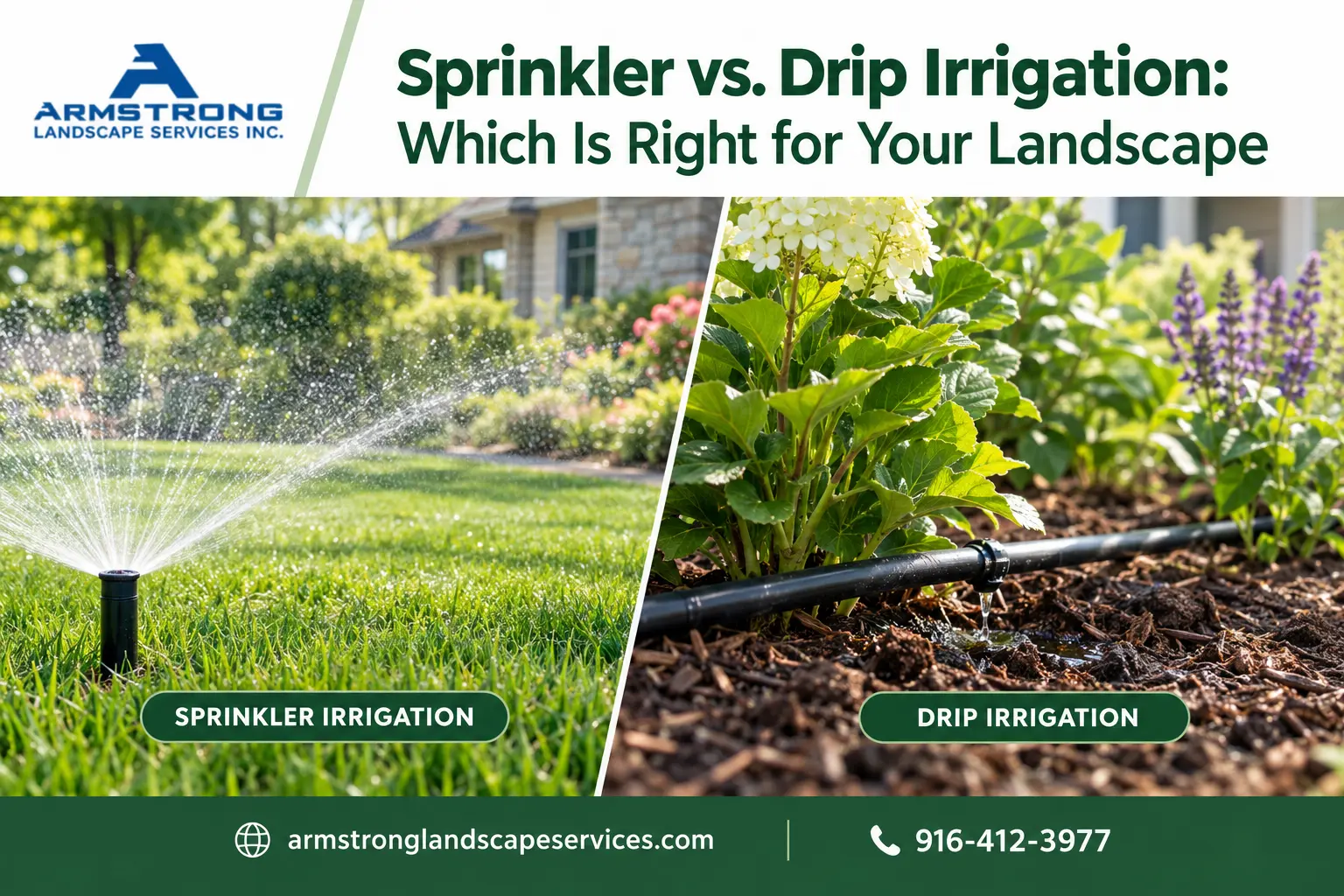
The easiest way to tell them apart is to look at where the water goes.
| Feature | Sprinkler Irrigation | Drip Irrigation |
| Best for | Lawns and open areas | Trees, shrubs, gardens, beds |
| Water delivery | Sprays across an area | Releases water near roots |
| Coverage | Wide | Targeted |
| Wind impact | Can affect spray | Very low |
| Overspray risk | Possible | Minimal |
| Typical run style | Shorter cycles | Slower, longer cycles |
| Common issue | Poor coverage or broken heads | Clogged or damaged emitters |
When Are Sprinklers the Better Choice?
Take a look at your lawn. If you have a large area of grass, you need a way for water to spread across your lawn without any obstructions. This is where sprinklers make sense.
They can cover front and backyard lawns, larger turf areas, new sod, and broader areas of groundcover. With the right spacing, the spray from one head overlaps with the next so the lawn receives more consistent coverage.
But simply having sprinkler heads in the ground doesn’t guarantee good coverage.
Here are some issues you might face with sprinklers:
- Overgrown shrubs can block sprinkler spray.
- Mowers or other yard work can knock sprinkler heads out of position.
- Clogged nozzles can prevent water from reaching parts of the lawn.
- Brown patches may appear even when the rest of the grass looks healthy.
- Running sprinklers longer can overwater areas that already receive enough moisture.
- Excessively high water pressure can create a fine mist that drifts away before reaching the soil.
When Is Drip Irrigation the Better Choice?
Drip irrigation works especially well for shrubs, trees, flower beds, vegetable gardens, raised beds, containers, and drought-tolerant landscaping.
Because water is released slowly, the soil has more time to absorb it. This can also help on slopes where fast watering might run downhill.
Drip irrigation is also less affected by wind and usually creates less overspray. This makes it useful around patios, sidewalks, driveways, and other hard surfaces.
Can One Yard Use Both Sprinklers and Drip Irrigation?
Yes, using both sprinklers and drip irrigation is actually more effective.
A lawn and a planting bed don’t have the same watering needs. If they are connected to the same irrigation zone, you may have to overwater one area just to give another area enough water.
For example, a yard might have:
- A front lawn
- Shrubs along the walkway
- Trees in a mulched bed
- A small backyard lawn
- Drought-tolerant plants along the fence
You can use a sprinkler for the lawn, while the beds and trees can have separate drip zones. This way, you can easily water each area according to what is growing there.
This approach also makes future adjustments easier. If one section needs more or less water, you can change that zone without changing the entire yard.
A good landscape irrigation system should fit the property rather than forcing every part of the yard onto the same watering schedule.
What Problems Should Homeowners Watch For in Both Sprinklers and Drip Irrigation?
Common problems with sprinklers include:
- Broken or tilted heads
- Water spraying onto pavement
- Clogged nozzles
- Plants blocking the spray
- Uneven pressure
- Dry spots between heads
Drip irrigation has its own set of problems:
It has small emitters that can clog if not cleaned regularly, tubing can get damaged, and leaks may be difficult to notice when the lines are covered by mulch. The system may also need changes as plants grow.
For example, a young shrub may start with one emitter near its base. As the shrub gets larger, the watering area may need to expand.
One easy way to check your system is to turn on each zone and watch it run. Check for leaks, dry spots, or water spraying where it should not.
Can Existing Sprinklers Be Converted to Drip?
In most cases, yes.
Most homeowners do this while removing part of a lawn and replacing it with shrubs, bark, decorative rock, or drought-tolerant plants.
Instead of abandoning the existing irrigation line, part of the system may be converted to supply drip irrigation.
However, conversion is not just about attaching drip tubing to an old sprinkler head. Drip systems commonly require pressure regulation and filtration, along with the right tubing, fittings, and emitters.
The existing valves and underground lines also need to be checked to see what can be reused. If you are already changing the landscape, converting an existing irrigation zone may be worth considering rather than starting over from scratch.
What Should Homeowners Consider Before Choosing the Irrigation System?
Before choosing an irrigation system for landscaping, ask yourself a few questions:
What Are You Watering?
Grass usually needs broad coverage. Individual plants usually benefit from water delivered closer to their roots.
How Much Sun Does the Area Get?
A sunny lawn can dry much faster than a shaded planting bed. Different areas may need different watering schedules.
How Does the Soil Handle Water?
Some soils absorb water slowly. If too much water is applied at once, it may run off instead of soaking into the soil.
How Will the Landscape Change?
Plants do not stay the same size. Shrubs can eventually block sprinkler heads, while trees develop larger root areas as they mature. Planning for those changes can save you from having to redo the irrigation system later.
Frequently Asked Questions About Sprinkler vs. Drip Irrigation
Should I replace my entire irrigation system if only one area has a problem?
Not necessarily. If the rest of the system is working properly, the problem may be limited to one valve, zone, sprinkler head, section of tubing, or controller. Replacing everything without finding the actual cause can add unnecessary work and expense. An irrigation inspection can help determine whether a repair, zone adjustment, partial replacement, or full system upgrade makes sense for the property.
How often should a landscape irrigation system be inspected?
Check your irrigation system at the start of the watering season and after major changes to your landscape. Also, adjust the controller as the weather changes. If you notice uneven watering or a sudden increase in your water bill, have the system checked by an expert.
Can drip irrigation be used for potted plants?
Yes. Drip irrigation can water potted plants by delivering water directly to the soil in each container. The number and placement of emitters depend on the pot size, plant type, and watering needs. Check the setup regularly to make sure the soil is not staying too wet or drying out too quickly.
How much does sprinkler or drip irrigation installation cost?
The cost depends on the size of your yard, the type of system you choose, and how much work is needed to install it. If you need to replace a few sprinkler heads, it will usually cost less than installing a new system or converting an existing one. For an accurate estimate, you should contact an irrigation professional who can look at your yard and explain what the project will involve.
Takeaway
When comparing sprinkler vs. drip irrigation, start with what you are watering.
Sprinklers are well suited to lawns and broad open areas. Drip irrigation works well around trees, shrubs, gardens, and planting beds. For many residential properties, using both is more practical than asking one system to handle the entire yard.
With the right setup, each part of the yard gets the water it needs on its own schedule.
Improve Your Irrigation With Armstrong Landscape Services Inc.
If you’re looking for professional sprinkler or drip irrigation services in Roseville, Armstrong Landscape Services Inc. can help.
Our owner, Brandon Armstrong, connects with every customer and provides professional sprinkler irrigation service in Roseville, CA, along with drip irrigation installation, irrigation repairs, system upgrades, and landscape improvements.
Whether you are dealing with poor lawn coverage, converting part of your yard to drip irrigation, or planning a new irrigation system for landscaping, our licensed team (CSLB #1110577)can help you find a setup that fits your plants, property layout, and watering needs.
Ready to improve the way your yard is watered? Call 916-412-3977 to discuss your irrigation project.