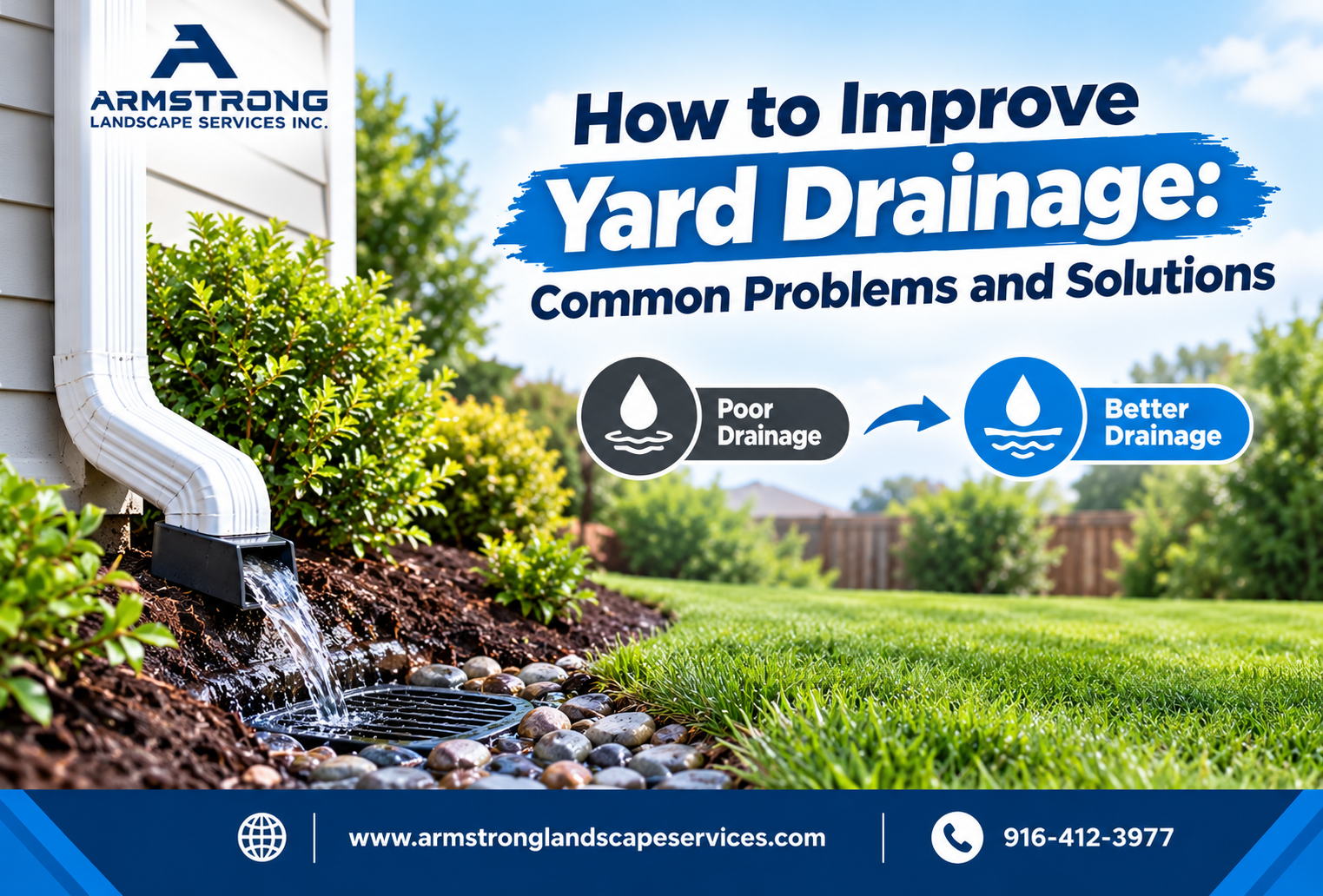
A little standing water after a heavy storm may not seem like much. But what if the same spot stays muddy for days? Or water keeps washing soil toward your patio, pooling beside the house, or leaving your lawn too wet to mow?
These are the signs that your yard may not be handling water properly. Water needs a clear path to move away from problem areas without damaging your lawn, plants, hardscape, or home.
In this guide, we’ll walk you through the most common causes of poor yard drainage and practical yard drainage solutions that can help.
Why Does Water Keep Pooling in My Yard?
Standing water usually means water is entering an area faster than it can soak into the soil or flow away. Several problems can cause this.
The Yard Has Low Spots
Even a shallow depression can collect a surprising amount of water. These low spots may develop as soil settles, especially around newer landscaping or areas that have been disturbed during construction.
Instead of moving across the property, rain and irrigation water simply settle into the lowest point.
The Ground Slopes the Wrong Way
Ideally, water should move away from the house and toward an appropriate drainage area.
If your lawn, side yard, or planting beds slope toward your foundation, patio, or garage, water will naturally follow that slope.
That’s why it’s important to look at the yard’s slope first and figure out where the water is going before installing any drainage.
The Soil Drains Slowly
Some soils absorb water much more slowly than others. Compacted or clay-heavy soil can hold moisture near the surface, leaving lawns soft and muddy long after the rain stops.
If water keeps sitting in the same area, the soil may be part of the problem, especially if the yard has poor grading or gets heavy runoff from nearby areas.
Too Much Irrigation Is Adding Water
Sometimes the problem is not rainfall at all.
A broken sprinkler head, leaking irrigation line, overspray, or watering schedule that applies too much water can leave one section of the yard soggy even when there has been no rain.
Therefore, before installing a drain, make sure irrigation is not creating the problem.
Is It Possible to Improve Yard Drainage?
Yes. If water simply needs a better path across the yard, correcting the grade may be enough.
Grading involves shaping the soil so water moves away from low spots and toward an appropriate drainage area. A shallow swale can also help. It is a gently shaped, low area that gives surface water a defined route instead of allowing it to spread across the yard.
| Solution | Best For | Main Limitation |
| Regrading | Poor slope or isolated low spots | Needs enough space and a suitable drainage path |
| Swale | Surface runoff across a yard | Requires available space |
| Catch basin | Water collecting at a specific low point | Needs a proper outlet |
| French drain-style system | Persistent subsurface or surface water | Requires careful planning and installation |
| Downspout drainage | Concentrated roof runoff | Only addresses water coming from the roof |
When Is a French Drain the Right Solution?
A French drain can be useful when water needs to be collected and redirected below the surface.
It may make sense for a soggy side yard, persistent low area, or part of the property where surface water cannot be managed with grading alone. But a French drain is not a universal solution.
The collected water still needs somewhere to go. If the outlet is poorly planned or the surrounding area cannot handle the flow, the problem may simply be moved somewhere else.
That is why good drainage work looks at the entire yard, not just one puddle.
Can You Improve Drainage Without Changing the Whole Yard?
Yes. A drainage correction does not always mean removing your entire landscape.
Drainage can be planned around existing lawns, planting beds, decorative rock, artificial turf, patios, walkways, and other features. For example, with the help of drainage additions, you may address one consistently wet side yard and leave the rest of the landscape untouched.
Existing drainage can also sometimes be repaired or improved instead of replaced.
This is particularly important when the yard already has established plants or hardscape that you want to keep.
California landscape guidance also recommends paying attention to drainage patterns and avoiding unnecessary soil compaction when planning landscape grading.
Should You DIY Yard Drainage or Call a Professional?
If you are dealing with a simple issue, you may be able to handle it on your own
For example, cleaning debris from a drain grate, correcting an irrigation schedule, or extending a downspout may be manageable for many homeowners.
But larger drainage work becomes more complicated because every change affects where water travels next. Quick DIY fixes often fall short because proper drainage requires careful planning. Before you dig, you need to know:
- Where the water originates
- The elevation of the property
- Where underground utilities may be located
- What type of drain is appropriate
- How much slope the pipe requires
- Where the water can safely discharge
- Whether nearby landscaping must be protected
- How the new drainage system connects with existing irrigation and hardscape
A poorly planned system can cost money without fixing the actual cause.
That’s why hiring a professional for residential yard drainage is especially valuable when flooding is widespread, drainage problems are close to the home, or several possible causes are involved.
Frequently Asked Questions About Yard Drainage
How much slope is needed for a yard drainage pipe to work correctly?
A yard drainage pipe needs a downward slope of at least 1/8 inch for every foot of pipe, though 1/4 inch per foot works much better. If the pipe is too flat, water sits still inside it. Over time, dirt and mud settle at the bottom and clog the whole pipe. Getting the right slope across a flat yard can be tricky to pull off on your own. Hiring an experienced drainage professional ensures your trenches and pipes are dug at the exact angle needed to keep water moving on its own without needing expensive electric pumps.
How do seasonal rains in Placer County affect yard drainage?
In Roseville and across the Sacramento Valley, long dry summers bake the clay ground hard as a brick. When winter storms hit, the hard soil cannot soak up heavy rain fast enough. Water quickly sweeps over the top of your lawn, washes away garden mulch, and pools around your foundation. Clearing out grates and adding downspout extensions before the rainy season starts helps prevent big trouble. An experienced drainage specialist can inspect your property and build a custom setup designed specifically for local clay soil and sudden winter downpours.
Why does my yard flood even when it hasn’t rained?
Irrigation may be part of the problem. Other possible causes include groundwater, poor grading, or water entering from another part of the property. Check whether the wet area appears after irrigation. If it does, an experienced landscaping professional can inspect both the irrigation and drainage systems instead of treating only one side of the problem.
Takeaway
If you’re also experiencing similar yard problems we mentioned above, don’t worry! Take a look at your yard. Check where water collects, when it happens, and what areas it affects. These small details can help you understand the best solution for your yard and have a more useful conversation with a landscaping professional.
Get Practical Yard Drainage Solutions From Armstrong Landscape Services Inc.
If standing water, soggy lawn, muddy side yards, or unwanted runoff is making your property difficult to enjoy, Armstrong Landscape Services Inc. can help.
We’re a locally owned landscape service company in Roseville. We provide professional yard drainage solutions and landscape drainage solutions for homeowners throughout Roseville, Rocklin, Lincoln, Granite Bay, and nearby communities.
As a licensed California contractor (CSLB #1110577), our team can handle all sorts of yard and landscaping issues. Our drainage services include property evaluations, new drain installation, drainage repair, catch basins, drainage additions, French-drain-style systems, downspout drainage coordination, runoff control, and drainage planning as part of larger landscape projects.
Instead of treating the wet spot alone, we first check the slope, soil, irrigation, hardscape, planting areas, and existing drainage to develop a solution suited to the entire yard.
Ready to make your outdoor space usable again? Call 916-412-3977 to discuss your residential yard drainage needs.